Tuesday, 11 October 2016

Chapter 12 Exploring Information System Development
October 10,2016. Monday

What is System Development? 
System is a set of components that interact to achieve a common
 goal.
Information system is a collection of hardware, software, data, people  and procedures that work together to produce information.

System development activities are grouped into phases, sometimes is  called the system development life cycle (SDLC).


•System development should follow three general guidelines:
-Group activities or tasks into phases
-Involve users 
-Define standards 

      System development should involve representatives from each  department in which the proposed system will be used 

•Project management is the process of planning, scheduling, and then  controlling the activities during system development. 
•To plan and schedule a project efficiently, the project leader identifies:
-Project scope 
-Required activities 
-Time estimates for each activity
-Cost estimates for each activity
-Order of activities 
-Activities that can take place at the same time 

 A popular tool used to plan and schedule the time relationships  among project activities is a Gantt chart 

      A PERT chart also can be used for planning and scheduling time 

•Feasibility is a measure of how suitable the development of a system  will be to the organization:
 -Operational feasibility 
 -Schedule feasibility 
 -Technical feasibility
 -Economic feasibility

 Documentation is the collection and summarization of data and  information
 -A project notebook contains all documentation for a single project

 Users and IT professionals refer to existing documentation when  working with and modifying current systems 

•During system development, members of the project team gather  data and information using several techniques
-Review documentation
-Observe
-Survey
-Interview
-JAD Sessions 
-Research

Who Initiates a System Development Project?
A user may request a new or modified system

Organizations may want to improve hardware, software, or other  technology

Situations beyond an organization’s control might require a change

Management might mandate a change

A user may request a new or modified information system using a  request for system services or a project request 


Planning Phase 
•The planning phase for a project begins when the steering commitee  receives a project request
•Four major activities are performed:
-Review and approve the project requests
-Prioritize the project requests
-Allocate resources
-Form a project development team

Analysis Phase
•The analysis phase consists of two major activities:
  1.Conduct a preliminary investigation
     -Determines and defines the exact nature of the problem or               improvement
     -Interview the user who submitted the request 
   2.Perform detailed analysis 
     -Study how the current system works 
     -Determine the user' wants, needs, and requirements 
     -Recommend a solution

•Process modeling (structured analysis and design) is an analysis and  design technique that describes processes that transform inputs into  outputs
  -Entity-relationship diagrams 
  -Data flow diagrams 
  -Project dictionary

 An entity-relationship diagram (ERD) is a tool that graphically  shows the connections among entities in a system

 Entities are objects in the system that have data 

 A data flow diagram (DFD) is a tool that graphically shows the flow  of data in a system
    -Data flows
    -Processes
    -Data stores
    -Sources 

 The project dictionary contains all the documentation and  deliverables of a project

 Structured English is a style of writing that describes the steps in a  process 

•A decision table is a table that lists a variety of conditions and the  actions that correspond to each condition
•A decision tree also shows conditions and actions, but it shows them  graphically

 The data dictionary stores the data item’s name, description, and  other details about each data item 

•Objectmodeling combines the data with the processes that act on that  data into a single unit, called an object. 
•UML(Unified Modeling Language)has been adopted as a standard notation for object modeling and development
-UML includes 13 different diagrams
-Two diagrams include:
   -Use case diagram
   -Class diagram
 A use case diagram graphically shows how actors (users) interact  with the information system

 Diagrams are considered easy to understand 

 A class diagram graphically shows classes and subclasses in a system
 Each class can have one or more subclasses
 Subclasses use inheritance to inherit methods and attributes of  higher levels 

•The system proposal assesses the feasibility of each alternative solution
•The steering committee discusses the system proposal and decides  which alternative to pursue
  -Packaged software
  -Custom software 
  -Outsourcing

Design Phase 
•The design phase consists of two major activities:
 -Acquire hardware and software
 -Develop all of the details of the new or modified information system

      To acquire the necessary hardware and software: 

•The next step is to develop detailed design specifications
  -Sometimes called a physical design:
      -database design
      -Input and output design
      -Program design

 Systems analysts typically develop two types of designs for each  input and output 

 A prototype (proof of concept) is a working model of the proposed  system
  -Prototypes have inadequate or missing documentation
  -Users tend to embrace the prototype as a final system
  -Should not eliminate or replace activities 

•Computer-aided software engineering(CASE)tools are designed to support one or more activities of system development
•CASE tools sometimes contain the following tools:
 -Project repository
 -Graphics
 -Prototyping 
 -Quality assurance
 -Code generator
 -Housekeeping 

 Many people should review the detailed design specifications
 An inspection is a formal review of any system development  deliverable
   –     A team examines the deliverables to identify errors 

Implementation Phase
•The purpose of the implementation phase is to construct the new or  modified system and then deliver it 
 -Develop programs
 -Install and test the new system
 -Train users
 -Convert to the new system
•The program development life cycle follows these steps:
  -Analyze the requirements 
  -Design the solution 
  -Validate the design 
  -Implement the design 
  -Test the solution
  -Document the solution 
•Various tests should be performed on the new system
 1.Unit test 
   -Verifies that each individual program or object works by itself 
 2.Systems test 
   -Verifies that all programs in an application work together properly
 3.Integration test 
   -Verifies that an application works with other applications 
 4.Acceptance test 
    -Checks the new system to ensure that it works with actual data 
 Training involves showing users exactly how they will use the new  hardware and software in the system
   –     One-on-one sessions
   –     Classroom-style lectures
   –     Web-based training 

 One or more of four conversion strategies can be used to change  from the old system to the new system 

Operation, Support, and Security Phase
•The purpose of the operation, support, and security phase is to  provide ongoing assistance for an information system and its users  after the system is implemented
  -Perform maintenance activities > Monitor system performance >         Assess system security
•A computer security plan should do the following:
 -Identify all information assets of an organization 
 -Identify all security risks that may cause an information asset loss
 -For each risk, identify the safeguards that exist to detect, prevent,     and recover from a loss. 

Saturday, 1 October 2016

Chapter 14 Enterprise Computing 
September 29,2016. Thursday

What Is Enterprise Computing ?
      Enterprise computing involves the use of computers in networks, such as LANs and WANs, or a series of interconnected networks that encompass a variety of different operating systems, protocols, and network architectures

Types of enterprises include:
 -Retail
 -Manufacturing 
 -Service
 -Wholesale
 -Government 
 -Educational
 -Transportation

      Most traditional enterprises are organized in a hierarchical manner 

•In an enterprise, users typically fall into one of four categories:
 -Executive Management 
 -Middle Management
 -Operational Management
 -Nonmanagement Employees
      Enterprise information is the information gathered in the ongoing       operations of an enterprise-sized organization
    –     Business intelligence
    –     Business process management
        Business process automation 
Managers coordinate resources by performing 4 activities:

   -Planning
   -Organizing
   -Leading

   -Controlling

Information Systems in the Enterprise

      An information system is a set of hardware, software, data, people,  and procedures that work together to produce information 

      Functional units within an enterprise might include:  
         •Enterprise
            -Accounting and Finance 
            -Human Resources
            -Engineering or Product Development
            -Manufacturing 
            -Marketing 
            -Sales
            -Distribution
            -Customer Service
            -Information Technology

 Accounting software manages everyday transactions

 Billing software helps the company reconcile purchases with
 customer payments

 Financial software helps managers budget, forecast, and analyze 

 A human resources information system (HRIS) manages one or more    human resources functions

Employee relationship management systems manage communication    between employees and the business 

Computer-aided design (CAD) uses a computer and special software    to aid in engineering, drafting, and design

 Computer-aided engineering (CAE) uses computers to test product    designs

Computer-aided manufacturing (CAM) is the use of computers to  control production equipment

Computer-integrated manufacturing (CIM) uses computers to  integrate the many different operations of the manufacturing process

Material Requirements Planning (MRP) uses software to help monitor  and control processes related to production

 Manufacturing Resource Planning II (MRP II) is an extension of MRP    and also includes software that helps in scheduling
 -A quality control system helps an organization maintain or improve   the quality of its products or services
 -A marketing information system serves as a central repository for  the tasks of a marketing department
•Managers coordinate resources by performing four activities
 Planning > Organizing > Leading > Controlling 

•A quality control system helps an organization maintain or improve  the quality of its products or services. 

•A marketing information system serves as a central repository for the  tasks of a marketing department.

 Sales force automation (SFA) software equips traveling salespeople  with the electronic tools they need to be more productive

•Distribution systems perform the following functions:
 -Provide forecasting for inventory control
 -Manage and track shipping of products 
 -Provide information and analysis on inventory in a warehouse 

 Customer interaction management (CIM) software manages the day-  to-day interactions with customers

 The information technology (IT) department makes technology  decisions for the enterprise
     –     Whether to build or buy new information systems
     –     When a computer or information system has outlived its useful            life

Web site management programs collect data designed to help    organizations make informed decisions regarding their Web presence 

•General purpose information systems generally fall into one of five  categories
-Office Information System 
-Transaction processing System 
-Management Information system 
-Decision support system 
-Expert System  

      Batch processing vs. online transaction processing 


• A Sample expert system in windows 7 Help and support


Enterprise-Wide technologies and Methodologies 
•Some technologies used in enterprises include:
 Portals

   -A collection of links, content and services presented on a web page      that are interesting for a particular job function
 Data warehouses

   -A huge database that stores and manages the data required to  analyze historical and current transactions
 Electronic data interchange

   -A set of standards that controls the transfer of business data and  information among computers both within and among enterprises
 Extranets

   -The portion of a company's network that allows customers or  suppliers of a company to access aprts of an enterprise's intranet
 Web services

   -Allow business to create products and B2B interactions over the  Internet
 Document management systems

   -Allows for storage and mangement of a company's documents
 Workflow
   -Process that identifies the specific set of steps involved in  completing a particular project or business process
 Virtual private networks
   - Provides mobile users, vendors and customers with a secure  connection to the company network server

  A portal is a collection of links, content, and services presented on a    Web page that are interesting for a particular job function 

 A data warehouse is a huge database that stores and manages the  data required to analyze historical and current transactions 

•EDI is a set of standards that controls the transfer of business data  and information among computer both within and among  enterprises.
•An extranet is the portion of a company's network that allows  customers or suppliers of a company to access parts of an enterprise's  intranet

Web services allow businesses to create products and B2B interactions  over the Internet

In a service-oriented architecture, information systems provide  services to other information systems in a well-defined manner over  a network

A document management system (DMS) allows for storage and      management of a company’s documents
        Stored in a repository 

A workflow is a defined process that identifies the specific set of steps  involved in completing a particular project or business process
        Workflow application 

      A virtual private network (VPN) provides mobile users, vendors, and  customers with a secure connection to the company network server 

Virtualization and Cloud computing 
•Virtualization is the practice of sharing or pooling computing  resources: 
1.Server virtualization
  -Provides the capability to divide a physical server logically into          many virtual servers 
2.Storage virtualization
  -Provides the capability to create a single logical storage devices 
•Cloud computing is an Internet service that provides computing needs  to computer users
•Grid computing combines many servers and personal computers on a  network to act as one large computer

E-Commerce

Enterprise Hardware
 Enterprise hardware allows large organizations to manage and store    information and data using devices geared for:
    –     Heavy use
        Maximum availability
    –     Maximum efficiency

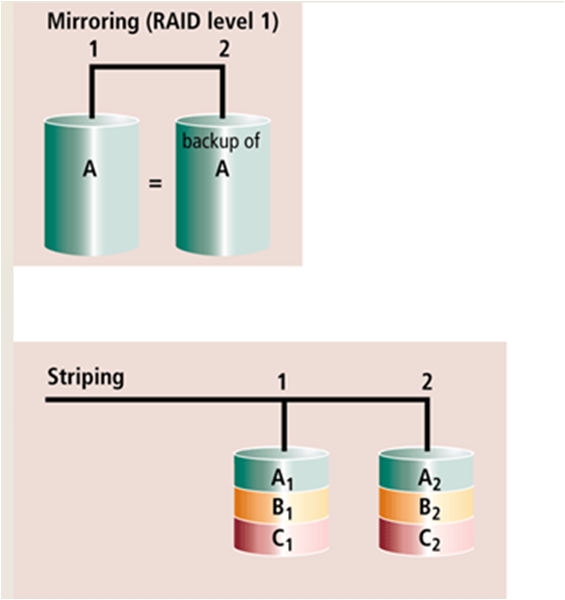
RAID duplicates data and
 implements duplication
 in different ways 


Network attached storage (NAS) is a server that provides storage to  users and information systems attached to the network

 storage area network (SAN) is a high-speed network that provides  storage to other servers to which it is attached 

 An enterprise storage system is a strategy that focuses on the  availability, protection, organization, and backup of storage in a  company

 Goal is to consolidate storage 

 blade server packs a complete computer server on a single card 
 (called a blade) rather than a system unit

 The individual blades insert in a blade server chassis 

 thin client is a small terminal-like computer that mostly relies on  a server for data storage and processing

The processing for a thin client usually is done on a server 

High Availability, Scalability, and Interoperability 
 high-availability system continues running and performing tasks  for at least 99 percent of the time
         –     May include hot-swapping
         and redundant components
                •      When a component fails, another
              component takes over and the
              system continues to function
 Scalability is a measure of how well computer hardware, software, or  an information system can grow to meet increasing performance  demands

Interoperability is the ability for an information system to share  information with other information systems within an enterprise

Backup Procedures 

Continuous data protection provides automatic data backup whenever  data is changed in an enterprise 

•A disadter recovery plan is a written plan describing the steps a  company would take to restore computer operations in the event of a  disaster 
•Contains four major components 
 -Emergency plan 
 -Backup plan 
 -Recovery plan
 -Test plan